The Beginnings and Early History of Albuquerque’s Water Supply
The “new town” grew quickly after the Atlantic & Pacific Railroad reached Albuquerque in April of 1880, and a water system, primarily for fire suppression in those early days, became an urgent need. The new Albuquerque Water Works Co. planned a diversion dam on the Rio Grande, a pumping plant, and a reservoir on the mesa east of town, but, following the example of the railroad, developed a groundwater supply instead. The water came initially from a large, shallow, rock-lined pit, next to a pumping plant, at the corner of Broadway and Tijeras Avenue.
The pumping plant, a 4-million-gallon reservoir at Central Avenue and Yale Boulevard on what
is now the UNM campus, and about 5-1/2 miles of water mains with fire hydrants, were completed in 1886. Although the huge steam-powered pump could push 3 million gallons per day up to the reservoir, it could lift water only about 7 feet by suction from the pit, and many wells close to and actually within the pit, some deeper than 700 feet, were added over time. All were in the same place to be close to the pump and boiler house.
The public was never happy with the water company, with its continuing financial and operational troubles, and generally terrible water quality. In 1918 the system was purchased by the City of Albuquerque and rapid expansion began. The first wells on the mesa east of
Broadway were drilled in 1950, and by then it was understood that the thick alluvial sands and gravels beneath the entire valley would support high-yield wells equipped with down-hole turbine pumps powered by electric motors. The single-source system became diversified, with well fields and reservoirs placed where the brisk post-World War II developments were occurring. By 1960, there were 83 wells in 14 well fields throughout the city.
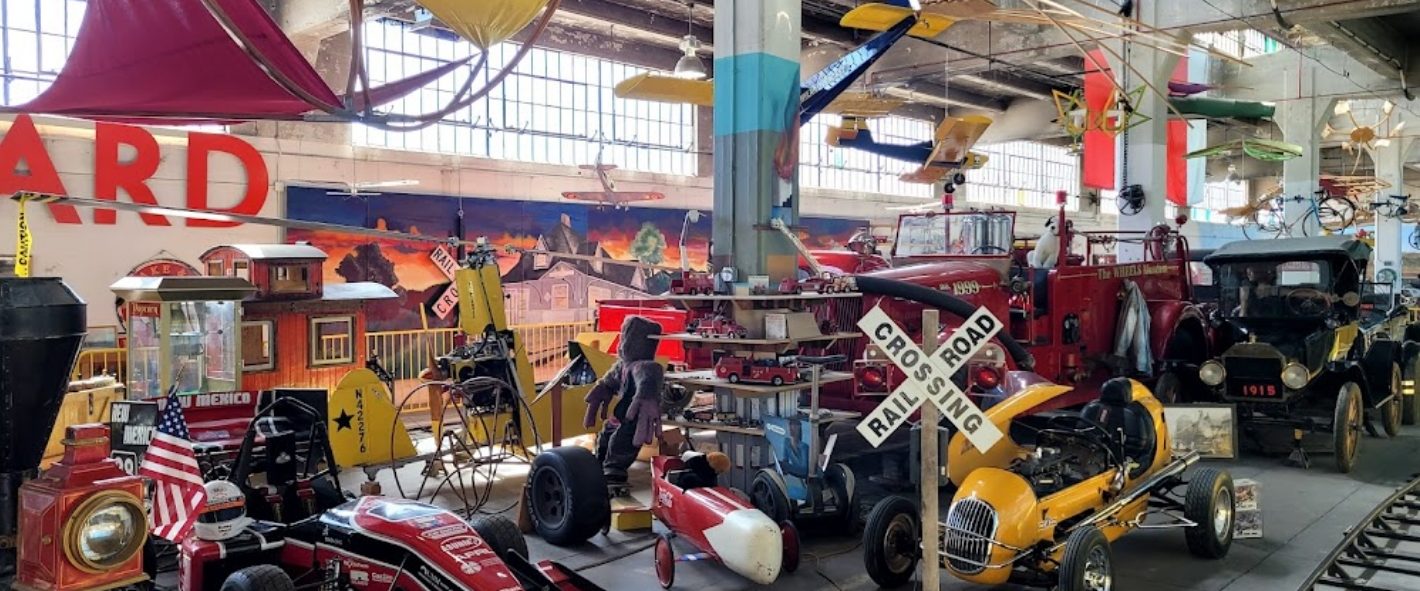
Wheels Museum
1100 2nd St SW, Albuquerque, NM 87102
Phone: (505) 243-6269